 “I just don’t like whole wheat.”
We hear that a lot. And almost every time, it turns out the problem was never the whole wheat. The problem was how old the flour was.
Whole wheat flour has an inconvenient property that nobody mentions in the baking aisle: it spoils quickly. Not in an obvious way — it doesn’t mold or visibly turn. It goes off slowly, quietly, in flavor only. The bread comes out faintly bitter or scratchy at the back of the throat, and whole grain takes the blame.
It is worth understanding why. Because the same explanation is the whole case for milling at home.
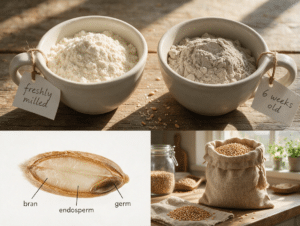
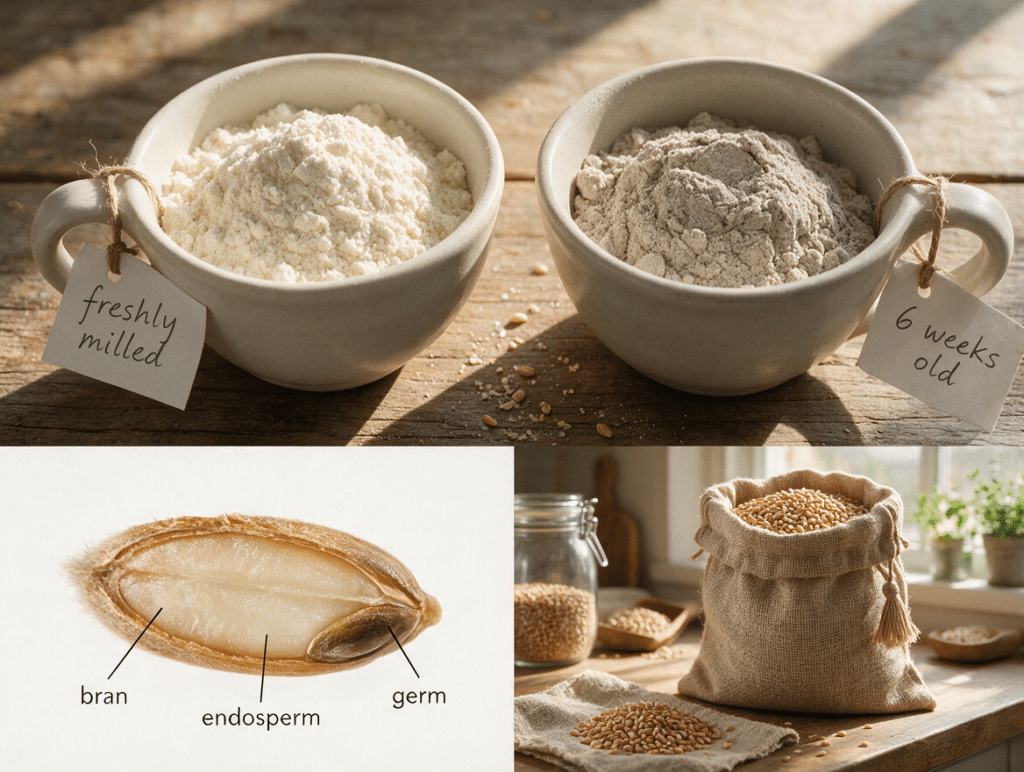
A grain kernel has three parts: the outer bran, the starchy endosperm, and the germ. The germ is the part that is supposed to become a plant, so it is generously equipped — with vitamins, minerals, enzymes, and fat as its energy store.
The whole kernel contains only a few percent fat overall, but the germ itself is markedly oil-rich. That oil is exactly what makes whole grain flour valuable. It is also exactly what makes it fragile.
White flour has the bran and germ removed. What’s left is essentially pure starch — inert, stable, good for many months. Whole wheat flour keeps everything. Including everything that can spoil.
As long as the kernel is intact, the oil is safely packaged. Cell structures keep it away from air and away from the enzymes that would break it down.
Milling destroys that arrangement in a fraction of a second, and two processes begin:
Enzymatic breakdown. Grain contains enzymes such as lipase, which split fats into free fatty acids. In an intact kernel this barely happens. In flour, enzyme and fat are suddenly in direct contact.
Oxidation. Those free fatty acids react with atmospheric oxygen. The compounds that form can be both smelled and tasted: first faintly oily, then bitter, eventually clearly rancid.
Both processes accelerate with warmth and light. A bag of flour that sits in a warehouse, then a truck, then a brightly lit grocery shelf has ideal conditions for all of it.
There is a nutritional cost as well. Vitamin E and several B vitamins are sensitive to light and oxygen and decline over storage time. So the flour loses not only flavor, but a good part of the reason people buy whole grain in the first place.
A practical rule of thumb:
| Shelf life (cool, dark, dry) | |
|---|---|
| Whole kernels | several years |
| White flour | 6–12 months |
| Whole wheat flour | a few weeks to about 3 months |
| Freshly milled flour | ideally right away, otherwise 1–2 days refrigerated |
The contrast between the first line and the last is the entire argument: whole grain is an excellent thing to keep in the pantry. Whole wheat flour is not.
How wide the gap between shelf life and quality really is becomes clear in the technical literature. A review of whole wheat flour stability puts the recommended storage limit at 15 to 60 days. Millers, meanwhile, stamp use-by dates of three to nine months after milling on whole wheat packages — and nine to fifteen months on white flour.
Neither figure is wrong. They simply measure different things. The printed date tells you how long the flour is safe to use. It tells you nothing about how it tastes.
Trust your nose before you heat the oven:
And the point that matters most in practice: rancidity does not bake out. What you smell in the bowl, you will taste in the bread.
Buy whole kernels, mill shortly before baking, and the entire problem never arises. Not because you manage it better — because it never starts.
How to store whole grain properly:
Stored that way, whole grain lasts for years without trouble. It is the most honest pantry staple a kitchen can hold.
Two things matter, and both come down to how the mill is built:
Temperature. Oils and vitamins are sensitive to heat. A slow-turning stone mill works far more gently than a fast steel burr mill. Our mills use natural granite millstones — granite conducts heat away well and keeps the flour cool as it comes out.
Quantity. Mill only what you actually need. If something is left over, seal it, refrigerate it, and use it within a day or two. For anything longer, mill again rather than store.
Which mill fits you depends mostly on how often and how much you bake. Our grain mill comparison is a good place to sort that out.
Whole grain isn’t bitter. Old whole grain flour is.
Anyone who has eaten bread made from flour that was still a kernel ten minutes before mixing understands the difference without further explanation. It is the same difference as between pre-ground coffee from a can and beans you grind yourself. Nobody needs it explained. You taste it.
Have you ever compared the two side by side? Tell us in the comments how it went — we’re curious.