October 16 is World Bread Day, and here in Salzburg, Austria, we can’t think of a better excuse to bake a loaf the way our grandparents did. If you’ve ever wanted to try a real Austrian farmhouse rye bread, now is the perfect moment: the evenings are getting crisp, your kitchen fills with the smell of caraway and crackling crust, and a fresh loaf on the table turns an ordinary weeknight into a cozy family supper.
In this post we’ll take you on a little tour of Austria’s bread culture, and then share our simple, family-style recipe for a Salzburg farmhouse loaf made with freshly milled rye and spelt.
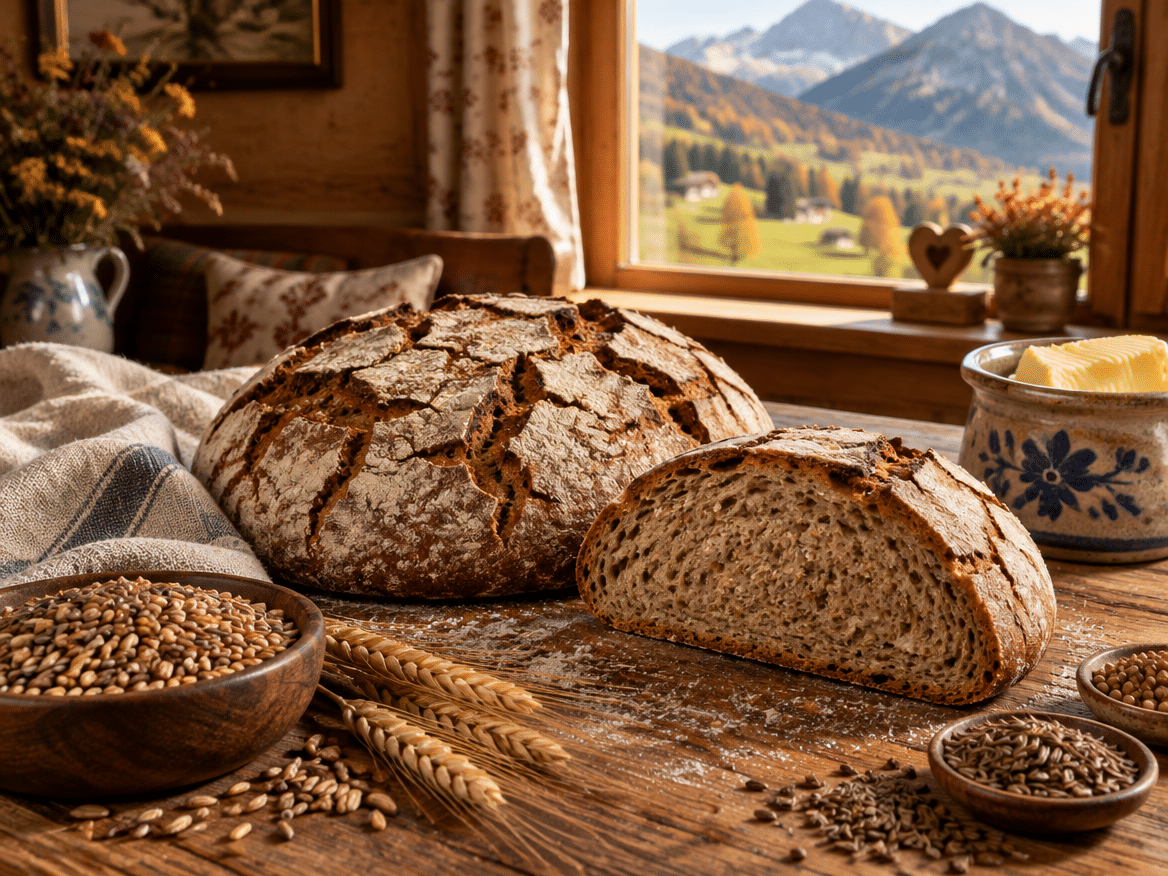
World Bread Day falls on the same date as World Food Day. Bakers around the globe use it to remind us how much craft, time and care goes into a good loaf, and how much work happens out in the fields before a kernel of wheat or rye can ever become flour.
Here in Hallein, near Salzburg, this day always makes us think of our grandparents. Bread used to be something precious. In many Alpine farmhouses, people would trace a cross on the bottom of the loaf with the knife before cutting the first slice, and nothing went to waste. Stale bread ended up in soups, dumplings or a sweet bread pudding. That kind of respect for bread is something we’d love to share with you.
Travel through Austria and you’ll notice right away that bread is never just bread. Every region has its favorites, and every bakery is a little world of loaves and rolls. A few classics:
In the Salzburg region, a proper Brettljause, a rustic wooden snack board, isn’t complete without a good farmhouse loaf: smoked ham, Alpine cheese, a little horseradish, radishes and a thick slice with a crackling crust. Think of it as Austria’s answer to a charcuterie board.
Good bread needs only a few ingredients: flour, water, salt and time, plus sourdough or a little yeast. What makes the difference is the quality of those few things.
When you mill your grain right before baking, the whole kernel ends up in your flour: the germ, the bran and the endosperm. Freshly milled whole grain flour smells like grain and has plenty of flavor of its own. Because it contains more bran, it absorbs a little more water, which keeps your bread moist longer.
A farmhouse loaf doesn’t like to be rushed. A long rest gives the sourdough time to develop flavor and helps the bread keep longer. Plan a relaxed baking day.
A great crust comes from high initial heat and steam in the oven. It protects the crumb and gives you that wonderful toasty flavor.
This is our simple basic recipe for one loaf of about 2.2 lb (1 kg). It works even if you’re new to sourdough; the small amount of yeast gives you extra confidence. Tip: with fresh-milled flour, a kitchen scale gives you the most reliable results, so we’ve added grams for each ingredient.
Mill the rye and spelt berries finely and put the flour straight into a large bowl. Mix in the salt and bread spice. You’ll notice how wonderful fresh flour already smells.
Dissolve the yeast in the lukewarm water. Add the water and sourdough starter to the flour and knead slowly for 8 to 10 minutes. Rye dough is sticky and stays that way. Don’t worry, that’s exactly how it should be. Wet hands or a bench scraper make it easy.
Cover the dough and let it rise in a warm spot for about 60 to 90 minutes. Shape it into a round loaf on a floured surface and place it seam side up in a well-floured proofing basket (banneton). Let it rise for another 45 to 60 minutes, until fine cracks appear on the surface.
Preheat your oven to 480 °F (250 °C), conventional setting, with a baking sheet or baking stone inside. Turn the loaf out onto parchment paper, slide it in and pour a small cup of water onto a hot pan on the bottom rack. After 10 minutes, briefly open the door to let the steam out, reduce the heat to 400 °F (200 °C) and bake for another 40 to 45 minutes. If the loaf sounds hollow when you tap the bottom, it’s done.
Our tip: Let the bread cool on a wire rack for at least two hours before slicing. Rye bread needs that time for the crumb to set, and it tastes even better the next day.
For us, the best moment in bread baking is when the freshly milled grain trickles into the bowl. With your Salzburg grain mill you can mill rye, spelt and wheat exactly when you need them, as fine or as coarse as your recipe calls for. You’ll find our mills and flakers, made for North American households, at natural-grainmills.us. Maybe World Bread Day becomes a brand-new tradition in your kitchen.
Give it a try, and let us know how your first Austrian farmhouse loaf turned out. We’d love to hear from you!