Here in Salzburg, Austria, the days grow shorter in late October, morning fog settles over the fields and the first candles begin to flicker in the village churchyards. That means All Saints’ Day is near, and with it comes one of our favorite family bakes: the Allerheiligenstriezel, a soft, lightly sweet Austrian braided bread topped with pearl sugar. Today we’ll share the story behind this authentic Austrian tradition and bake one together with freshly milled spelt, a recipe from our family in Salzburg.
Here in the US, November 1 comes right after Halloween. So while your neighbors are still counting candy, why not bake a golden braided loaf that smells of butter and lemon? It also makes a beautiful bread for your Thanksgiving table later in the month.
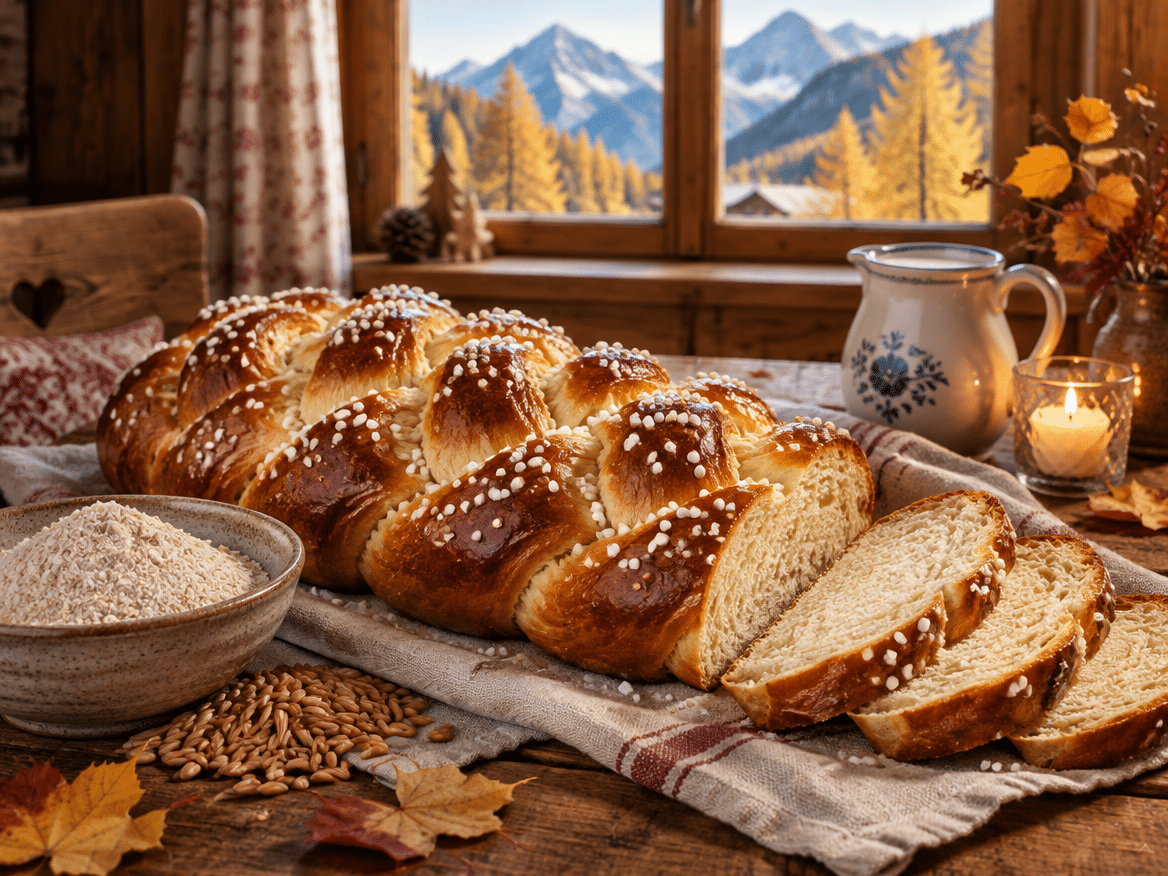
In Austria and neighboring Bavaria, All Saints’ Day (Allerheiligen) on November 1 is a public holiday, and there’s a lovely old custom that goes with it: godparents give their godchildren a braided sweet bread called a Striezel. In our Austrian dialect, the godfather is affectionately called Göd and the godmother Godn. For many kids it’s one of the highlights of the fall. In some places the loaf is said to be bigger the younger the godchild is, and it gets a little smaller over the years. How exactly it’s done varies from family to family and village to village.
All Saints’ Day and All Souls’ Day on November 2 are quiet days of remembrance in Austria. Many families visit the graves of loved ones, decorate them with arrangements and light candles. It’s often said that the braided shape recalls an old mourning custom in which women cut off their braids as a sign of grief. Whether that’s really true can’t be said for certain today. What we love is that a day of remembrance has given us a bake that brings families together.
At home in Hallein, just outside Salzburg, the Striezel is simply part of the day. After visiting the cemetery, the family gathers in the warm living room with coffee or hot chocolate, and the braid is cut into thick slices. Some eat it plain, others with butter and jam.
Spelt is wonderful for yeast baking. Freshly milled, it has a mild, slightly nutty flavor, and the whole kernel, including germ and bran, ends up in your flour. A few tips will help your braid turn out soft and fluffy:
Makes 1 large braid or 2 small ones (perfect for gifting). Hands-on time about 30 minutes, plus about 1 1/2 hours rising and 30 to 35 minutes baking. With fresh-milled flour, a kitchen scale gives you the most reliable results, so we’ve added grams for each ingredient.
Mill the spelt berries finely. Stir the yeast and a teaspoon of the sugar into a little of the lukewarm milk and let it sit for a few minutes. In a large bowl, combine the flour, remaining sugar, salt and lemon zest. Add the yeast mixture, the rest of the milk, the egg and the butter, and knead for 8 to 10 minutes by hand or with a stand mixer into a soft, smooth dough. If you like, knead in the raisins at the end.
Cover the bowl with a kitchen towel and let the dough rise in a warm spot for about 60 minutes, until it has noticeably grown. In a cool fall kitchen it may take a little longer.
Divide the dough into four equal pieces and roll each into a rope about 16 inches (40 cm) long, a little thicker in the middle and thinner at the ends. Lay the ropes side by side and pinch them together at the top. Now always take the outside left rope and weave it over the second, under the third and over the fourth, until it’s on the far right. Then repeat with the new left rope. At the end, pinch the ends together and tuck them under the loaf.
Prefer a classic three-strand braid? That works just as well. We showed you how in our braided harvest bread with freshly milled grain.
Place the braid on a parchment-lined baking sheet, cover it and let it rise for another 30 minutes or so. Meanwhile, preheat your oven to 350 °F (180 °C), conventional setting. Brush the braid with the egg wash, sprinkle with pearl sugar and bake on the middle rack for 30 to 35 minutes until golden brown. If it browns too quickly, tent it loosely with foil after 20 minutes. When the bottom sounds hollow as you tap it, it’s done.
Our tip: wrapped in a kitchen towel, the braid stays soft for two to three days. Leftovers make amazing toast with butter, or the best French toast you’ll have all fall.
Every year we love the moment when freshly milled spelt trickles into the bowl and, a little later, the scent of the braid fills the whole house. With your Salzburg grain mill you mill your flour exactly when you need it, as fine as your yeast dough likes it. That’s how an old Austrian custom becomes your own homemade family tradition. You’ll find our mills and flakers, made for North American households, at natural-grainmills.us.
Give it a try and bake a braid this fall for your godchild, your family or just for yourself. We’d love to hear how it turned out!