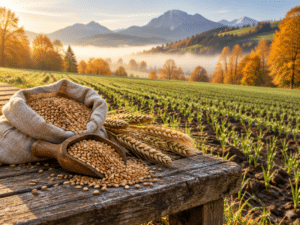
Here in Salzburg, Austria, October mornings often start with mist hanging low over the fields. Look closely and you’ll spot thin green rows on freshly planted fields, barely as long as your finger. That’s winter wheat, along with winter rye and spelt: grain that’s planted now in the fall, spends the winter under the snow and is ready to harvest next summer. Today we’d love to take you along on that long journey, from a field in the Austrian Alps all the way to your grain mill.
And if you live in the US, this story may sound familiar. Right now, farmers across the Great Plains are doing exactly the same thing with their winter wheat.
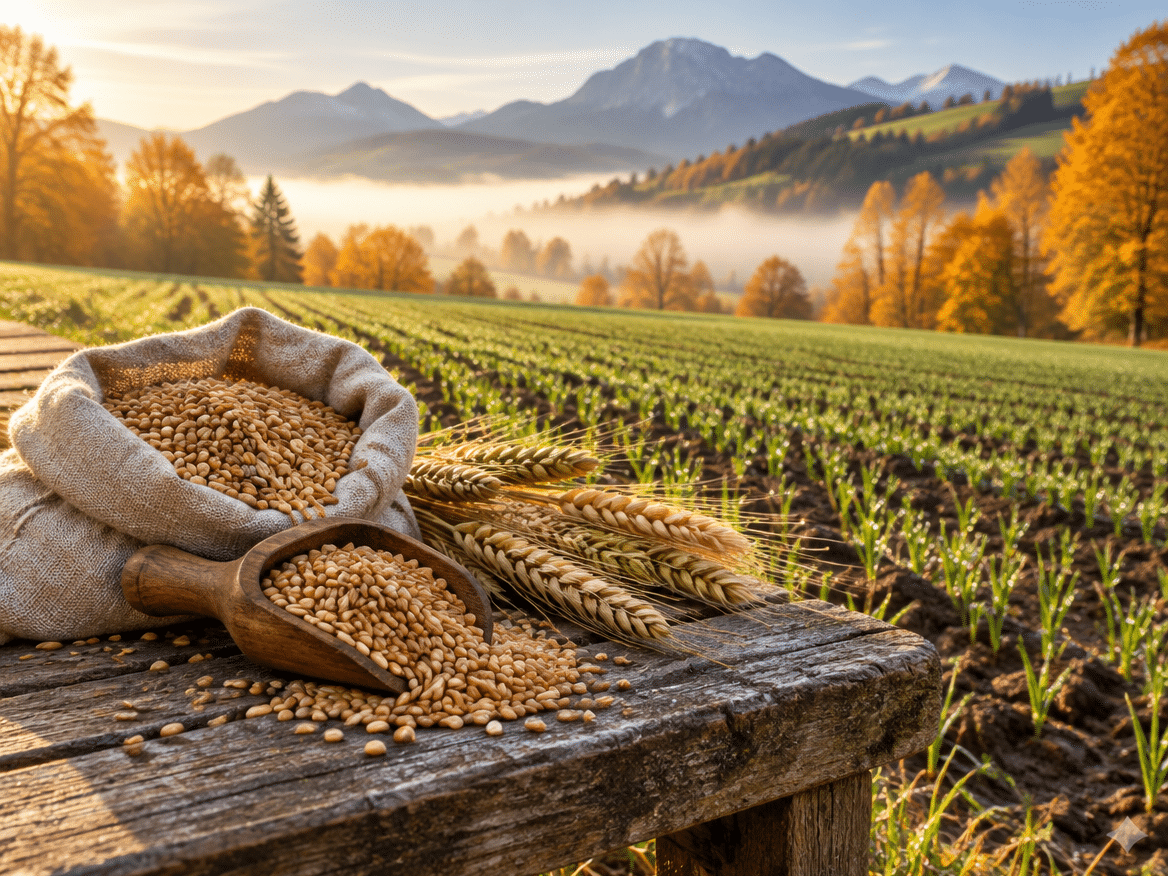
Winter wheat and other winter grains are planted in the fall and spend the winter in the field as young plants. What makes them special: many varieties actually need the cold. Only after a long chilly spell do they form their heads of grain in spring. Scientists call this vernalization. Plant winter wheat in spring, and it often won’t produce a proper crop.
The most important winter grains are:
Oats are a different story. They’re a classic spring crop, planted in March or April along with spring barley and millet. So the oats you roll for breakfast come from a field that was planted in spring.
Kansas is famous as the “Wheat State,” and much of its crop is hard red winter wheat. It’s planted in early fall, sleeps through the cold months on the wide-open plains and is harvested in early summer. Along with neighboring states like Oklahoma and Nebraska, the Great Plains grow a big share of the wheat that ends up in American bread. Many home millers love hard red or hard white wheat berries for their sandwich loaves.
Our fields here in Austria are much smaller, and the Salzburg region is mostly meadows and alpine pastures. Grain fields are more common in the rolling Flachgau area north of the city and further out toward Upper Austria. But the rhythm of the year is the same: plant in the fall, rest in winter, grow in spring, harvest in summer.
Depending on the variety, location and weather, winter grain goes into the ground from late September into November. Barley and rye are usually planted a bit earlier, wheat and spelt a little later. Within a few days to a few weeks the seeds sprout, and by the first frost the young plants have a few leaves and start to tiller, meaning they send out side shoots.
In winter, growth nearly stops. A blanket of snow is actually a gift for the little plants, protecting them from bitter cold like a cozy comforter. Hard frost without snow is much tougher on them. Here in the mountains, there’s hardly a prettier sight than a snowy field with next year’s bread already sleeping underneath.
As soon as the ground thaws and the days get longer, the plants take off. They keep tillering, shoot upward, and the heads of grain emerge in late spring. Then come flowering and grain fill.
When the fields turn golden and the kernels are hard, the combines roll. In Austria that’s usually July and August. The grain is then cleaned, dried to the right moisture level and stored. And that’s where the part of the journey that ends in your kitchen begins.
You may be wondering: if wheat is harvested only once a year, how can your flour taste fresh in February or May? The answer is the kernel itself. A whole wheat berry is a tiny, perfectly packed pantry. The bran protects the germ and the endosperm, and as long as the kernel is intact and dry, its nutrients stay well protected.
The kernel only opens up when you mill it. From that moment, oxygen reaches the oils in the germ, and the flour slowly loses its flavor. That’s why we like to mill right before baking. We explain why store-bought whole wheat flour can even turn bitter over time in this post: Why store-bought whole wheat flour turns bitter — and freshly milled doesn’t.
Look for well-cleaned, food-grade wheat berries, rye or spelt, ideally from a farm or supplier you trust. The kernels should be dry, pour freely and smell pleasantly of grain, never musty.
Linen or paper sacks and wooden boxes are the traditional choice in Austria. Many American home millers use food-grade buckets with tight-fitting lids for larger amounts. For everyday use, glass jars or canisters with lids work well, as long as the grain is really dry.
A pantry, a dry basement or a cool cabinet is ideal. Avoid spots next to the stove, a heater or the laundry room, because grain doesn’t like warmth or humidity.
Take a peek at your supply every so often: does the grain smell good, and are there no uninvited guests like pantry moths? Then simply mill what you need for your bread, cookies or breakfast.
Our tip: stored well, whole grain keeps for many months, often much longer. So you can stock up on your favorite wheat berries now and be ready for a whole season of holiday baking, from Thanksgiving rolls to Christmas cookies.
For us, this is where the circle closes every fall: outside, the fields are being planted, and inside, last summer’s grain trickles freshly milled into the bowl. With your Salzburg grain mill you bring that moment into your own kitchen. You mill wheat, rye and spelt exactly when you need them, with the whole kernel and all its flavor in your flour. You’ll find our mills and flakers, made for North American households, at natural-grainmills.us.
Next time you drive past a freshly planted field, take a moment to look. Next summer’s bread is growing right there. We think that’s a lovely thought for a misty fall day.