The backpacks are by the door and the notebooks are labeled. Which means that from Monday on, the same question arrives every evening: what goes in the lunchbox tomorrow?
These three recipes are built to answer it once, for the whole week. All three can be made on a weekend, all three keep for days or go straight into the freezer, and all three still taste good at ten in the morning — after four hours in a backpack.
School food has different requirements than the bread you pull out of the oven on a Sunday afternoon.
It has to taste good cold. Plenty of bakes that are excellent warm turn flat at room temperature. Assertive ingredients — carrot, cheese, seeds — carry flavor without the help of oven heat.
It can’t go soggy. A firm, tight crumb handles moisture far better than an airy white loaf.
It has to be eaten one-handed. A short lunch period leaves no time for assembly.
And it should hold longer than third period. This is where whole grain earns its place: fiber from the bran and germ slows digestion, so blood sugar rises more gently than with white flour. Not a miracle — but a real difference between “made it to lunch” and “hungry again by ten.”
Kids are honest tasters. If whole grain bread tastes bitter or scratchy, it comes home uneaten and the reputation is set.
But that bitter note people associate with whole grain doesn’t come from the whole grain. It comes from the age of the flour. The oils in the germ oxidize once milled, and bagged whole wheat flour has usually had weeks to do exactly that. Freshly milled flour tastes nutty and faintly sweet instead.
Mill fine for all three recipes — on a Salzburg Grain Mill that takes only a few minutes. Spelt tends to win kids over faster than wheat, being milder and gently nutty, but whole wheat works throughout.
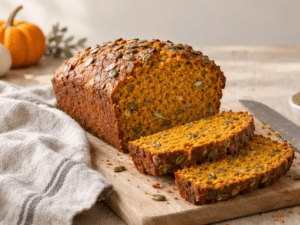
The workhorse of the lunchbox. Grated carrot keeps it moist for days, and children who otherwise steer around vegetables eat it without a second thought — all they see is orange flecks.
For one 9 × 5 in (25 cm) loaf pan, about 16 slices
Combine all dry ingredients. Add water and vinegar and stir vigorously for three to four minutes — this is a soft batter, not a kneaded dough.
Stir in the grated carrot and the seeds, holding back a spoonful of seeds for the top.
Scrape into a greased loaf pan, smooth the surface, scatter the reserved seeds. Cover and let rise 45 to 60 minutes.
Bake at 375 °F (190 °C) for 45 to 50 minutes. Tap the bottom: a hollow sound means it’s done.
Cool completely before slicing, or the crumb turns gummy. Wrapped in a linen towel it stays fresh for four days.
The vinegar is not a typo: it makes the batter more supple and noticeably extends freshness. You won’t taste it.
Bake twelve on Sunday, freeze eleven. Take one out the night before and it has thawed by morning — no reheating, no planning.
For 12 rolls
Knead everything for eight to ten minutes into a supple dough. Whole grain dough feels sticky at first — don’t add much flour, it firms up as you work it.
Cover and rise for about 60 minutes, until noticeably increased in volume.
Divide into twelve equal pieces and shape round or oblong. Set on a sheet pan, brush with water and dip into seeds or oats.
Rest another 25 minutes.
Bake at 400 °F (200 °C) for 15 to 18 minutes, until golden.
Cool completely, then bag them individually. They keep well for up to three months.
For the days when the fridge has run out of anything spreadable. The cheese is already inside, nothing else is needed — and muffins register as cake with children, whether or not they are.
For 12 muffins
Whisk flour, baking powder, salt and pepper in one bowl. In a second, whisk milk, eggs and melted butter.
Stir the two together only until no dry flour remains. Overmixing makes muffins tough — a few lumps are exactly right.
Reserve two tablespoons of cheese for the tops.
Fill the muffin tin, scatter the reserved cheese and bake at 350 °F (180 °C) for 20 to 25 minutes.
The muffins keep three days in a sealed container and freeze well too.
The moisture trap. Cucumber and tomato will soak any bread. Pack them in their own compartment, or lay a lettuce leaf between bread and filling.
The Sunday routine. One baking morning covers the whole week: carrot loaf in the pan, rolls on the sheet, muffins in the tin. The oven is on anyway.
Let them choose. Children reliably eat what they had a hand in picking. Offering two options is enough — the decision feels big to them and costs you almost nothing.
We wrote a separate piece on how taste actually develops in children, and why whole grain sometimes needs a few tries: Kids & Whole Grains – how taste is learned.
Here’s to a good start to the school year.
Which lunchbox bake comes home empty most reliably at your house? Tell us in the comments — we’re collecting ideas for a second round.